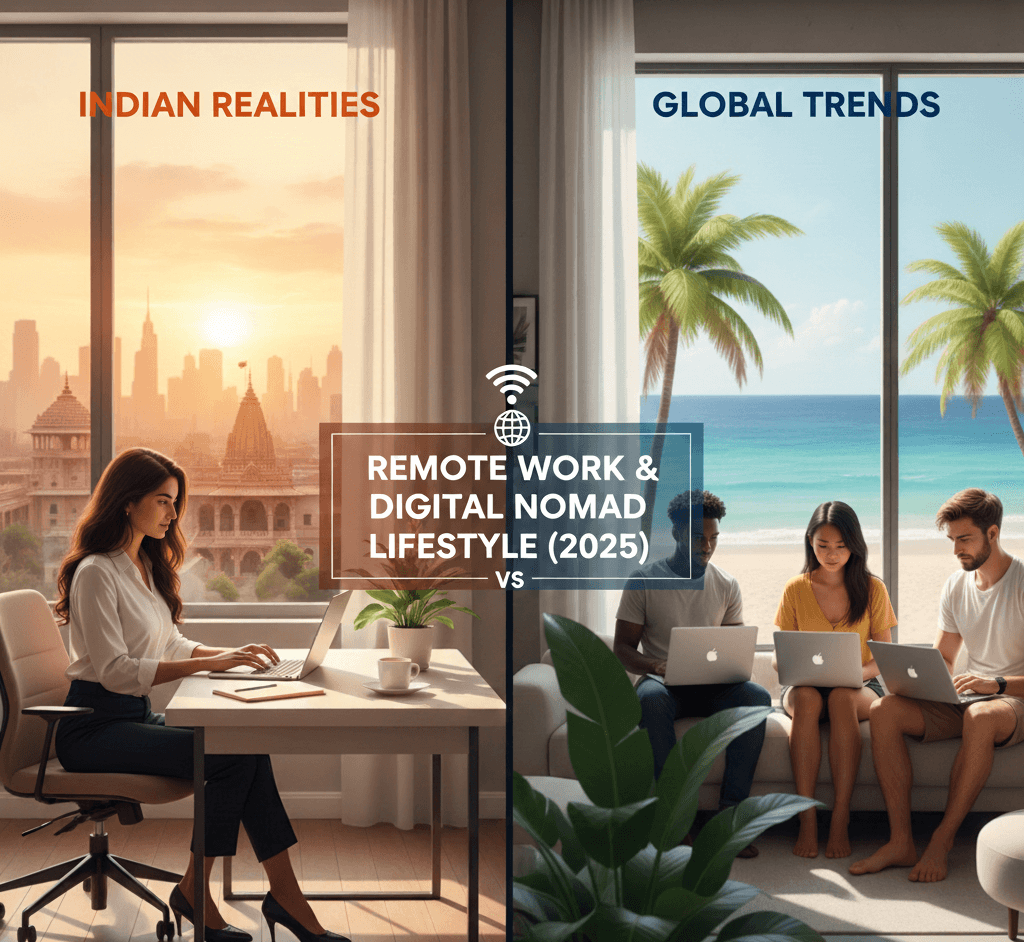
The world of work has changed more in the last five years than in the last five decades. Remote jobs, hybrid offices, and the rise of digital nomads have transformed how people connect, create, and earn. In 2025, this shift is even more visible, but the experience is not the same everywhere. India has its own version of remote work culture, shaped by infrastructure, lifestyle, and opportunities, while global trends paint a slightly different picture.
This article explores how remote work and digital nomadism look in India today, how they compare with global patterns, and what the future holds for Indian workers aspiring to live a location-free life.
Remote Work in 2025: A Global Snapshot
Globally, remote work is no longer an experiment; it’s a standard option. Companies in the U.S., Europe, and Southeast Asia widely offer flexible models because:
- They reduce office costs
- They access global talent easily
- Employees demand flexibility
- Productivity has proven stable or higher
Countries like Portugal, Spain, Thailand, and Indonesia even promote digital nomad visas, attracting remote professionals to boost their economies.
Coworking spaces, long-stay hostels, and high-speed internet zones have become an essential part of the digital lifestyle worldwide.
Indian Reality: A Growing but Uneven Shift
India embraced remote work during the pandemic, but the transition hasn’t been completely smooth. While tech, marketing, content, and startup sectors still offer remote roles, many traditional companies prefer hybrid or office-first models.
Here’s what defines the Indian remote work reality:
- Hybrid work is more common
Most Indian companies prefer 2–3 days of office because they feel collaboration and discipline work better in person.
- Tier-2 and Tier-3 cities are booming
Remote jobs have allowed people to move back to hometowns like Indore, Bhopal, Lucknow, Surat, Coimbatore, etc.
Cost of living drops, and quality of life improves.
- Internet is improving, but not universal
Metros enjoy great connectivity, but smaller towns still face unstable networks, affecting full-time remote workers.
- Work culture remains time-bound
While global remote workers enjoy flexible hours, Indian employees often follow strict 9-6 timing even when working from home.
- Fewer digital nomad opportunities
India does not yet offer a digital nomad visa for foreigners or locals.
Also, constant travel is not affordable for many Indian professionals.
Digital Nomad Lifestyle: How India Differs from the World
The digital nomad lifestyle sounds fun laptops on beaches, co-working in mountains, and new cities every month but the reality is very different for Indians compared to global nomads.
Global Nomad Lifestyle
- Earn in dollars/euros
- Use strong passports
- Travel freely to cheaper countries
- Stay in hostels/coworking spaces easily
- Work from cafes, beaches, and long-stay apartments
Countries like Thailand, Vietnam, Mexico, Bali, and Portugal are hotspots for global nomads because they offer low living costs and great connectivity.
Indian Nomad Lifestyle
- Most earn in INR, which reduces purchasing power
- costs and visa Travel costs and visa restrictions limit long stays abroad
- Indian passport rank affects mobility
- Accommodation and travel inside India are affordable, but not always internet-friendly
- Popular Indian nomad zones: Goa, Manali, Dharamshala, Rishikesh, Pondicherry, Udaipur
Indian nomads mostly travel within India, not globally, due to cost and visa limitations.
- Why Your Crypto Wealth May Never Reach the Next Generation And How to Protect It
- Social Security Christmas Boost 2025: Millions Set to Receive Two Payments in December—What You Should Know
- Remote Work & Digital Nomad Lifestyle, Indian Realities vs Global Trends (2025)
- The Final Betrayal: Who Gets Your Crypto and Photos When You Die? (The $10,000 Digital Ghost)
- The Most Expensive Question in Science, Is CRISPR Building a Health System Only Billionaires Can Afford?
Big Opportunities for Indians in the Remote Work World
Despite limitations, the future is bright. India has some huge advantages:
- Global companies want Indian talent
Tech, design, editing, marketing, customer support, cybersecurity, finance, and AI roles are open worldwide. Indian workers are skilled and cost-efficient, making them highly desirable.
- Freelancing and gig work are booming
Platforms like Upwork, Fiverr, Toptal, Contra, and LinkedIn Marketplace help Indians earn in dollars.
- Startups are hiring remotely
Indian startups prefer remote teams to cut office costs.
- Skill-based hiring is growing
Your skills matter more than your location.
Challenges Indians Still Face
Even though opportunities exist, challenges cannot be ignored:
- Payment gateways and tax complications for international earnings
- High competition on global freelancing platforms
- Noise, power cuts, and internet disruptions in some areas
- Work-life balance issues due to long hours
- Lack of Indian digital nomad visas
These challenges slow down the dream of becoming a full-time location-independent worker.
Future Predictions: What 2025 and Beyond Will Bring
✔ More Indian companies will accept remote-first culture
Especially in IT, finance, and creative fields.
✔ Co-working and co-living spaces will rise in tourist cities
Goa, Himachal, Kerala, and Uttarakhand will become India’s remote-work hubs.
✔ Advanced AI tools will make remote work easier
Automation will reduce manual tasks.
✔ More global remote jobs will open for Indian workers
Hiring without borders is becoming normal.
✔ India may eventually introduce a digital nomad visa
Several discussions are already ongoing, and it could be a game-changer.
Remote work and digital nomadism are here to stay, but the experience of an Indian worker is very different from someone in Europe or Southeast Asia. While global nomads enjoy easy visas and high payouts, Indians are building their own version of a flexible lifestyle shaped by affordability, tech growth, and work culture. In 2025 and beyond, India will continue evolving. With better infrastructure, more remote opportunities, and increasing global demand for Indian talent, the idea of “work from anywhere” is becoming more real every day.
Leave a Reply